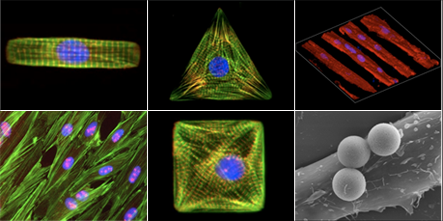
The Disease Biophysics Group (DBG) at Harvard University is an interdisciplinary team of biologists, physicists, engineers and material scientists actively researching the structure/function relationship in cardiac, neural, and vascular smooth muscle tissue engineering.
Read More »

What's New

The President of Sogang University in South Korea visits the DBG! May 20th, 2013

On May 7th, The President of Sogang University in South Korea visited the DBG as part of the growing collaboration between Sogang University and Professor Kevin Kit Parker’s research group at SEAS.  President Ki Pung Yoo was accompanied by Jae Ho Roe, Vice President, Office of International Affairs, Sogang University; Jeong-Woo Choi, Director in Institute of Integrated Biotechnology; and Hang Duk Roh, Professor Ex-Director in Research Institute of SK Chemical.  After lunch with Professor Parker, where they discussed the international collaborations and academic exchanges between Sogang and Harvard, the visitors toured the DBG and saw the research being conducted by our two visiting researchers from Professor Kwanwoo Shin’s research group at Sogang University, Seungkuk Ahn and Hyojin Ko.  Dr. Sung Jin Park, a Postdoctoral Fellow in the DBG, also presented his research to the group.  The visit concluded with a tour of the Wyss Institute in the Longwood Medical area.

Boston’s largest Korean mass media outlet, BostonKorea, featured an article about the visit to the DBG and Wyss Institute.  Click here to access the article online, which is written in Korean.

Congratulations to Dr. McCain!! April 28th, 2013

Congratulations to Dr. Megan McCain who has accepted a position as Assistant Professor of Biomedical Engineering at the University of Southern California! She will arrive in LA to start building her laboratory at USC in Jan 2014. Congrats to Professor McCain!!

Welcome to the DBG!! April 17th, 2013

Welcome to the DBG!! April 15, 2013
The DBG would like to welcome Roza Mahmoodian, who joins us as a postdoctoral fellow from Massachusetts Institute of Technology’s Lab for Material Chemomechanics, under the direction of Professor Krystyn J. Van Vliet. We also welcome Hyojin Ko from Sogang University in Korea as a visiting student. The DBG is excited to have both joining the group! Welcome.

Images from the DBG April 17th, 2013

Ventricular cardiomyocytes from neonatal rats can be cultured on substrates coated with extracellular matrix proteins anisotropically. These cardiomyocytes can grow according to spatial cues provided by proteins attached to a substrate. Soft-lithography allows for customizable, micron-scale protein patterns to be “stamped” onto a substrate. This allows for building tissues that more closely resemble their orzanization in vivo. This image shows cardiomyocytes aligned to 10 micron wide lines of fibronectin separated by 10 micron wide lines of fibronectin at a lower concentration.
Photo by Borna Dabiri

Disease Biophysics Group Postdoctoral Fellow Positions January 18th, 2013

The Disease Biophysics Group at Harvard University invites applications for a number of Postdoctoral Fellow positions open for projects pertaining to building microscale models of diseased organs. The project requires the assembly of engineered, human microtissues in microfluidic devices that can be interrogated for the genetic, morphological and functional indicators of health, disease, and injury.

The Disease Biophysics Group is a multidisciplinary research group based in the Harvard School of Engineering and Applied Sciences, the Wyss Institute for Biologically-Inspired Engineering, and the Harvard Stem Cell Institute.

Candidates with experience in neuronal cell biology, striated and smooth muscle tissue engineering, the cardiac valves, and experimental models of diabetes are encouraged to apply. Applicants are expected to hold a doctoral degree in engineering, physiology, or cell biology and have a proven record of high quality publications.

Application Procedure

The application will be assembled as single pdf file: cover letter describing research interests and goals, CV, research statement, a full list of publications and up to three examples of first author papers, and a list of no less than three references with contact information.  Please note that all requirements for the doctoral degree must be completed prior to the start date.  The application should be sent to:dbg-postdoc@seas.harvard.edu

Full consideration will be given to all applications received by February 15, 2013; applications received thereafter will be considered until the positions are filled.

Harvard University is an equal opportunity employer. Women and underrepresented minorities are particularly encouraged to apply.

Featured Publications

54.  Agarwal A, Farouz Y, Nesmith AP, Deravi LF, McCain ML, Parker KK. Micropatterning Alginate Substrates for In Vitro Cardiovascular Muscle on a Chip. Adv. Funct. Mater. (Web): 19 MAR 2013.

53. Nawroth JC, Parker KK. Design standards for engineered tissues. Biotechnol Adv. 2012 Dec 23. doi:pii: S0734-9750(12)00198-X. 10.1016/j.biotechadv.2012.12.005. [Epub ahead of print] PubMed PMID: 23267860.

52.  Kuo P, Lee H, Bray MA, Geisse NA, Huang YT, Adams WJ, Sheehy SP, Parker KK. Myocyte shape regulates lateral registry of sarcomeres and contractility. Am. J. Pathol. 2012; 181(6):2030-7.

51. Deravi LF, Su T, Paten JA, Ruberti, JW, Bertoldi K, Parker KK. Differential Contributions of Conformation Extension and Domain Unfolding to Properties of Fibronectin Nanotexiles. Nano Letters. 2012; 12 (11):5587–5592.

50. Nawroth JC, Lee H, Feinberg AW, Ripplinger CM, McCain ML, Grosberg A, Dabiri JO, Parker KK. A tissue-engineered jellyfish with biomimetic propulsion. Nat Biotechnol. 2012;30;792-797.

49. Dabiri BE, Lee H, Parker KK. A potential role for integrin signaling in mechanoelectrical feedback. Prog Biophys Mol Biol. 2012; 110: 196–203.

48. Sheehy SP, Grosberg A, Parker KK. The contribution of cellular mechanotransduction to cardiomyocyte form and function. Biomech Model Mechanobiol. 2012 Jul 7. [Epub ahead of print]